![image of a busy downtown area for a mobility and transportation business [background image]](https://cdn.prod.website-files.com/image-generation-assets/4fb1c9d3-0500-4637-8361-0f606a955fed.avif)
If you ask what brand awareness means, you’ll probably hear answers like:
That sounds right, but it’s surface-level.
It reduces brand building to visibility and repetition.
It assumes the game is only about being seen and remembered.
But that’s a problem.
Recognition should not be the only goal.
Being remembered for the right thing when it matters should.
Because what if you're being remembered for the wrong things?
Teams used to think they were building awareness.
In reality, they were chasing impressions.
Chasing vanity metrics.
Optimizing headlines for clicks, not memory or building belief.
They’re pouring money into reach while ignoring what actually gets stored and recalled when it matters.
Marketing became obsessed with numbers and chasing attention.
But attention is scarce, and it doesn’t necessarily lead to growth especially when it’s fueled by hype with no connection to the actual problem you solve.
Brand awareness isn’t a CPM.
It’s not a traffic spike.
It’s not last week’s brand recall survey, nor your viral LinkedIn post.
Real brand awareness is built across time, across touchpoints, and through emotionally resonant moments that stick and resurface in brand-relevant moments.
In high-stakes B2B, the wrong memory can cost you a quarter’s pipeline without you even knowing it. And if your awareness lives only in ad impressions, it dies the moment your budget does. That’s the cost of being stuck with old playbooks.
.jpeg)
Current growth strategies and GTM are too focused on visibility and not focused enough on memorability.
And even when brands are being remembered, it’s often for the wrong reasons:
Why? Because they’re still focused on the wrong things.
Chasing attention. Speaking to everyone the same.
Running hype campaigns and spamming lead magnets.
But not journey-mapping or adding frictionless real value.
And not building brand awareness with the kind of memory associations that help buyers understand your product value.
So we get brands people see everywhere and remember nowhere.
Think about the last SaaS ad you saw.
You might remember the punchline - but do you remember what they actually solve?
Or why you would ever need their product?
Or care about the brand at all?
Traditional brand awareness theory, shaped by researchers like Keller, Rossiter, and Percy, defined as:
“The ability of the buyer to recognize or recall the brand when given a product category or need.”
That led to a model based almost entirely on two things:
At the time, this was useful. But in today’s digital fragmented landscape where the average person likely sees hundreds of ads daily, it falls short. Because being visible does not equal being remembered spcially when your target audience is bombarded by ads and content everyday.
Before web-2 transformation made impressions feel like the whole game, marketing scholars were already thinking deeper about brand value. One of the most influential voices was David Aaker; a legendary professor at UC Berkeley’s Haas School of Business, author of over 100 published articles and 17 books on branding, and often called the father of modern brand strategy. His work shaped how global companies from Toyota to IBM approached brand building.
In 1991, Aaker introduced his Brand Equity Model, a framework that defined brand equity as the set of assets and liabilities linked to a brand that add to or subtract from the value a product or service delivers. In plain language: brand equity is what your brand is worth in the market’s mind, beyond the product itself.
Aaker broke it into five core components:
In Aaker’s view, awareness is the foundation. it’s what anchors the brand in memory so that loyalty, perceived quality, and associations can form and grow. He illustrated this with the Brand Awareness Pyramid, which moves from no awareness to recognition, to recall, and finally to top-of-mind. Without that base layer, the rest of the brand equity structure has nothing to stand on.
Studies in b2b sales consistently show that brands with high awareness not only capture higher market share but can command price premiums because in moments of choice, the remembered brand feels like the safer, more credible bet.
Just look at the CRM software market. What brands come first to your mind? And how much are they charging these days?

Classical definitions placed too much emphasis on brand name recall, assuming that awareness only exists if a buyer can name the brand.
But that’s incomplete.
Awareness can exist even if the name doesn’t come to mind. People often recognize a look, a color, a tagline, or a voice even if they forget the actual name.
These are brand identifiers - things like logos, slogans, sounds, beliefs, writing style, or packaging. They act as cues that trigger memory without needing to recall the name.
So awareness isn’t just about name recognition. It’s about what sticks in memory and why.
In 2022, researchers Bergkvist and Taylor proposed a more complete definition. They reframed brand awareness not as something passive, but as something performance-based:
“Brand awareness is the likelihood that a person retrieves a brand identifier and a category need from memory across brand-relevant situations.”
This shifted awareness from static recall to retrieval in context. In other words, can people remember you when a brand moment surfaces?
Like when a friend asks, “What’s the best AI tool for lead gen?” You’ve probably heard of a few. Maybe tried a few more.
But in that moment, the brands you recall first are the ones you’ve experienced. That’s the difference between being seen and being remembered when it matters.
Their study inspired me to start Sequence Theory. It shed light on a core problem faced by most founders and GTM teams: if you don’t understand what real brand awareness means, you may be actively damaging your brand image.
That’s one reason why today’s average ad conversion rates hover around three percent. When you focus on simple visibility instead of memory-driven belief, you win impressions but lose impact.
One of the problems with the classical view is that it didn’t distinguish between long-term awareness and short-term attention.
Someone might recognize a brand simply because they were primed - [recently exposed to a subtle brand cue, like an ad or social post] - but that doesn’t mean they actually remember it over time.
Real awareness should not depend on chance exposure.
It should hold steady across time, platforms, and situations whether or not someone was just shown an ad.
So what makes awareness last?
It comes down to memory nodes - [mental connections between a brand and the ideas, benefits, or emotions it's associated with].
The stronger and more emotional those links are, the more likely someone is to remember the brand when it counts.
Think of it like this:
This is what makes a brand show up when someone says:
These aren’t campaign moments. They’re decision moments. And only the brands with the right memory structure will show up.
They showed that brand awareness is not just a result of recognition. It is shaped by memory nodes; the mental connections between a brand and associated ideas, needs, or benefits.
Marketing, product experiences, advertising, and messaging all play a role in strengthening these nodes. The stronger and more emotionally relevant the connections, the more likely someone is to retrieve the brand in a meaningful situation.
As powerful as this evolution is, something is still missing.
Because brand retrieval alone doesn’t create belief.
And being remembered isn’t the same as being chosen.
To actually shape buying intent, there’s another layer - a deeper shift that most brand strategies still ignore.
And that’s where we go next.
Previous models talked about recall and recognition.
But those are just outcomes.
They describe what brand awareness looks like - not how it actually gets built.
And they don’t reflect how memory, context, and digital behavior really work today.
So we dived deeper into these inishts and asked:
Here’s the Sequence Theory view of brand awareness, based on how memory is built.
Every touchpoint leaves a memory trace; a small imprint in the brain tied to a brand.
But not all traces are equal.
And not all awareness leads to action.
Memory can form in different ways:
All three can create awareness. But the outcomes are not the same.
Let’s compare a few real-world examples:
So memory traces can originate either through repetition, and triggering emotion or resonance with the audience. But product experiences, founder insights, conversations, or peer referrals - that’s where real buyers memory is formed.
Yes, logos, colors, taglines, and even sounds are brand identifiers.
They help people recognize a brand.
But recognition alone isn’t enough.
People don’t always remember the name but they might remember what the brand stands for.
“The one that helps remote teams.”
“The one with the frameworks that actually work.”
“The one that doesn’t sound like every other SaaS.”
This is where belief, not branding, creates memory.
When someone can’t recall your name but can describe your value.
Awareness only works if it's linked to a need.
If it’s not tied to a real use case or job-to-be-done, it’s just noise.
You want your brand to surface when someone says:
“We’re not converting inbound.”
“We need a tighter GTM layer.”
“Our team is overwhelmed with junk leads.”
If your brand doesn’t come up in those moments, it’s not because people never heard of you.
It’s because your awareness isn’t linked to need states - the specific contexts where decisions are made.
Most brands fall short here.
They prioritize leads over memory. They gate demos, hide products behind forms, and push conversion before connection.
But without experiencing the benefit, nothing sticks.
A landing page pitch is insufficient. Show, do not tell. If showing is not possible, tell in a way that creates belief.
A visitor who spends two minutes using your product is more valuable than a ghost lead who never saw what you solve.
People remember moments of value: smooth onboarding, a founder video that reframes the problem, or a clear benefit felt in action.
These touchpoints shape memory.
They build what Bergkvist and Taylor call performance-based brand awareness: not just "have they seen you," but "will they remember you in the moment that matters."
This led us to explore further: what drives retrievable awareness in brand-relevant situations?
Sometimes, people recognize your brand due to recent priming: an ad, a post, or a headline with your name.
But this is not true memory. It is short-term familiarity from recent exposure.
Bergkvist and Taylor cautioned against this. Priming is situational; it may influence immediate recall but does not create lasting brand awareness.
Real awareness is stable across time, platforms, and contexts. It does not depend on being top of feed but on being top of mind, triggered by meaning, relevance, and emotional connection.
Marketing and advertising help only when they strengthen memory nodes, the internal network of associations linked to your brand.
If awareness fades when the ad disappears, you were never known for something.
Brands don’t live in isolation.
They live in memory networks.
A memory node is a concept or belief or benefit stored in someone’s mind and linked to a brand.
The stronger and more emotional that node is, the more likely it gets retrieved.
Your brand is remembered not just for what it says, but for what it is associated with.
For example:
Increases the chance it gets retrieved when someone faces a GTM problem.
That’s how awareness becomes action.
Brand awareness is not static. It evolves.
What people remember about you shifts with every touchpoint: product friction, pricing regret, support moments, or simply time.
Beliefs change.
So do the associations stored in buyer memory.
Then, what people stored:
These traces came from teaching, belief-shaping, and a clear identity, reinforced by orange visuals and educational content.
Now, what some store, based on user reviews:
These shifts stem from post-sale friction, like high costs or complex contracts.
Sequence Theory insight: When product experience breaks the belief, price overshadows the philosophy.
What Salesforce says it is:
What different buyers store, per user feedback:
Persona Memory Trace
SMB Buyer: “Aggressive reps flooding my inbox ” Too costly for our team”
Enterprise Buyer: “Everyone uses it” “Safe but rigid”
Marketer: “Needed consultants to implement” “Confusing, bloated UI”
Sequence Theory insight: Brand memory is situational. Different personas form unique beliefs, often misaligned with the marketed image.
Brand awareness is neither passive nor permanent.
It’s built from memory traces, and not all drive growth.
Every interaction leaves a mark: a tweet, a demo, a support reply, a landing page, a founder post.
Some moments build trust and relevance. Others dilute the story or damage it.
A viral ad can spark attention but be forgotten if it lacks context.
A slick product that fails onboarding becomes a negative memory.
A CEO’s viral post can overshadow the offer if it lacks relevance.
That’s memory without meaning. It confuses, not converts.
Strong brand memory anchors to context, emotion, and timing:
These are job-triggered memories, tied to the jobs-to-be-done framework. They live closer to action, not just recognition.
True awareness is not “top of feed.” It’s “top of context.”
Your brand is not the asset you launched.
It’s the memory people store after real interaction.
Every support reply rebuilds trust.
Every friction point creates a new trace.
Every exceeded expectation, like delightful onboarding, strengthens recall.
If your product fails the promise, awareness becomes a negative signal.
If your content entertains without solving a job, it’s noise.
Awareness is not about being remembered.
It’s about being remembered for the right thing.
Memory traces can reinforce or erode trust, driven by sensory cues like colors, social proof like peer recommendations, and emotional moments.
Belief formation continues beyond the funnel, in product use, support chats, and shared workarounds.
One-liner to cement the insight:
Your brand is not the campaign you launched. It’s the memory shaped through interactions that can make or break your brand image → Brand your buyer's sequence.
Brand awareness is not recall of a name. It’s retrieval of belief.
People store meaning, not taglines.
They remember how you made them feel.
They come back when the moment demands it.
Here’s what creates that kind of awareness:
People store beliefs, not feature lists.
They remember, “We don’t build funnels. We build sequences.”
Not, “We support X, Y, and Z integrations.”
Tone, color, shape, energy — all must reinforce the brand.
Consistency builds familiarity.
Familiarity builds trust.
Buyers remember how your brand made them feel.
Seen. Understood. Challenged. Inspired.
That emotion becomes part of the brand memory.
The best brands are not remembered for the category.
They are remembered when the pain returns.
They don't lead with what they do, but with what they solve and why it matters.
When the pipeline dries up. When the handoff fails.
You want to be recalled in the moment, not just the market.
Brand awareness isn’t built in a campaign.
It’s built in demos, Slack threads, team debates, community chats, and shared documents.
These are the real brand moments.
Brand Awareness =
Beliefs + Identifier Consistency + Emotional Impression + Need Fit + Sequenced Touchpoints
Let's assume you are launching an app that automates workflows with AI. Many are thinking the same these days. Booming business. You launched the app, and you want to start running campaigns.
According to the Sequence Framework, you would first have to frame the problem and help buyers understand the real pain of staying with their outdated workflow.
This is the first belief you have to shift:
From “My workflows are fine” to “I am actually consuming too much time on these tasks compared to my peers in the industry.”
In your messaging, whether it is an ad, social media post, or cold call - you must include some of your brand identifiers and display them as frequently as possible in front of your target buyers, but only in relevant contexts that guide their sequence.
You must also evoke emotions that positively contribute to building confidence and trust in your brand, your mission, and your understanding and point of view on the problem you solve.
At last, you go and build sequenced touchpoints per persona through outreach, content, and digital ads deployed when it matters most, based on signals like engagement, social behavior, or sales interactions.
This is how you build awareness driven by belief.
From “I don't have a problem” to “This is the best thing I've done for my business this year.”
Brand Awareness — Traditional View vs. Sequence Theory View
Traditional GTM pushes to be seen.
Sequence Theory aims to be remembered.
Not in the moment of the ad.
In the moment the pain returns.
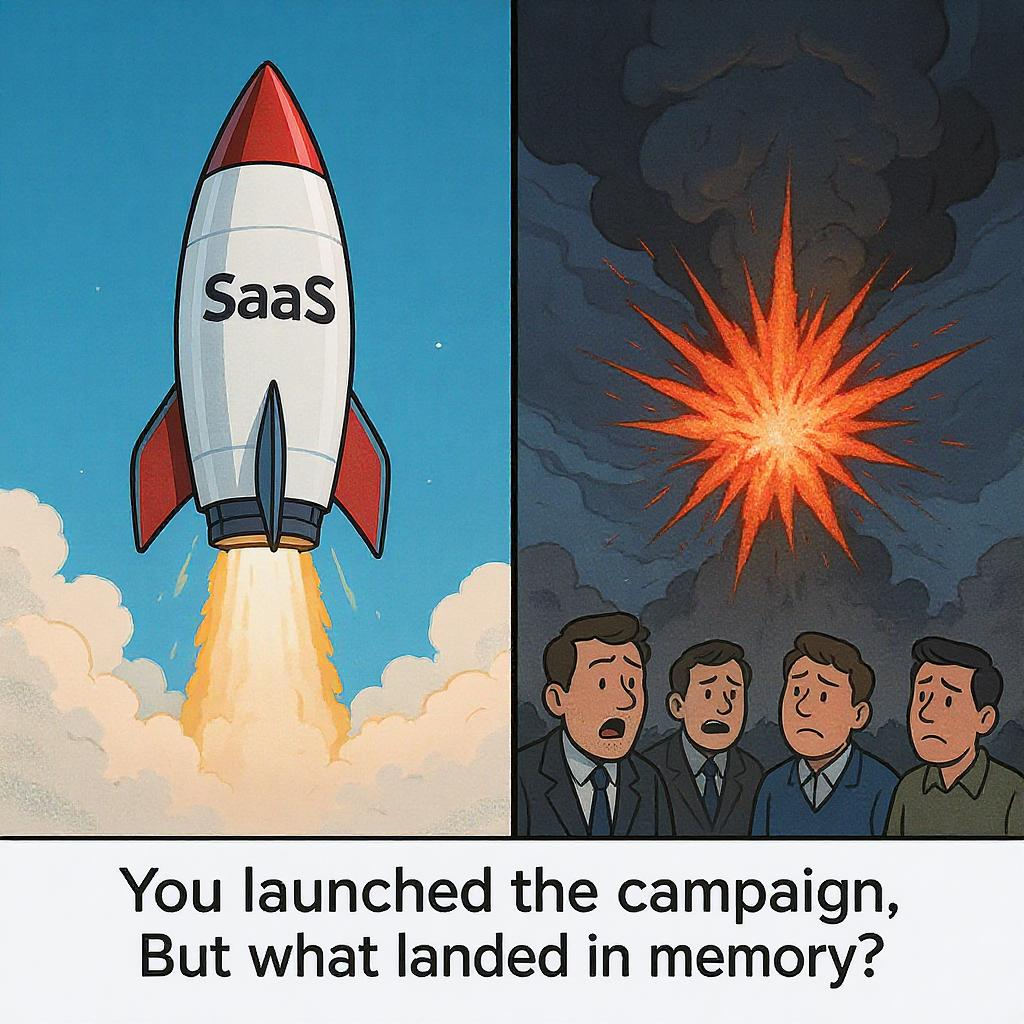
Most SaaS teams think they’re building awareness.
But they’re actually building the wrong memory.
Six real-world PR failures we studied had the same root problem:
They got attention, but lost belief.
The product worked.
The content shipped.
The campaign hit the feed.
But it didn’t stick for the right reason.
Belief was missing.
Trust was broken.
Perception collapsed.
Because brand awareness, when not grounded in memory and meaning, can backfire.
Brand awareness is the likelihood that brand identifiers, beliefs, and emotional impressions are retrieved from memory across all relevant contexts.
Not just at purchase.
But during:
From “Who are you?”
To “What do I believe about you?”
From name recall
To meaning retrieval
From visibility
To memorability
From stickiness
To situational relevance
Because awareness doesn’t always lead to action.
And being remembered doesn’t guarantee belief.
If someone doesn’t believe they have a problem, they won’t go searching for a fix.
They’ll scroll past.
They’ll ignore the ad.
They’ll tune out the pitch.

Our formula says:
Brand Awareness = Beliefs + Identifier Consistency + Emotional Impression + Need Fit + Sequenced Touchpoints
When any pillar breaks, memory collapses. Below are ten cases where visibility gained attention but destroyed trust.
What happened: In 2024, Artisan AI’s NYC and SF billboards proclaimed “Stop hiring humans” to push automation. Impressions soared and Artisan claimed $2 M ARR, but media (TechCrunch) and 70 % negative X sentiment called it “tone-deaf” and “dystopian.”
Sequence break: Fearful shock (say) created negative emotion (feel), not confidence in AI.
Source: TechCrunch (“Stop Hiring Humans” campaign)
What happened: A September 2022 SMS phishing attack exposed Zendesk customer data (SecurityWeek). Days of silence drove frustration and 15 % drop in satisfaction.
Sequence break: Promised “customer-first” support (say) vanished under delayed response (do), leaving users feeling abandoned (feel).
Source: SecurityWeek
What happened: A 2012 credential breach exposed 68 M accounts (SecurityWeek). Dropbox’s slow, vague messaging undermined its “secure platform” promise.
Sequence break: Delayed clarity (do) shattered trust (feel), creating a lasting memory of vulnerability.
Source: SecurityWeek
What happened: By 2015, HubSpot’s early inbound goodwill gave way to aggressive upsells. G2 reviews show a 20 % churn spike from pricing complaints.
Sequence break: Friendly inbound philosophy (say) clashed with hard-sell tactics (do), leaving users feeling hustled (feel).
Source: G2 Reviews
What happened: In 2023 Marketo touted “enterprise automation” but delivered complex setup that 25 % of users reported in G2 surveys.
Sequence break: Promise of simplicity (say) was broken by unusable complexity (do), frustrating buyers (feel).
Source: G2 Surveys
What happened: Airtable’s 2021 plan changes introduced hidden limits. TrustRadius data show 25 % churn and 35 % citing unexpected fees.
Sequence break: “Transparent pricing” (say) was undermined by complex limits (do), producing betrayal (feel).
Source: TrustRadius
What happened: In 2018, Moz cut tiers and raised prices up to 140 %. SaaS Mag reported 30 % churn and widespread outrage.
Sequence break: Value promise (say) collapsed under price shock (do), eroding loyalty (feel).
Source: SaaS Mag
What happened: On January 4, 2021, Slack suffered a five-hour outage. The Guardian noted sparse updates and 30 % drop in G2 satisfaction.
Sequence break: “Always-on collaboration” (say) failed in practice (do), creating frustration (feel).
Source: The Guardian
What happened: Intercom’s 2022 pricing overhaul introduced hidden fees. G2 reviews show 40 % negative sentiment and a 25 % churn increase.
Sequence break: Promise of flexible pricing (say) was broken by unexpected costs (do), causing resentment (feel).
Source: G2 Reviews
What happened: Throughout 2020, Zoom delivered reliable video at scale. Harvard Business Review credits 300 % user growth and “lifeline” branding.
Sequence break: None. Promise of seamless connection (say) matched flawless delivery (do), building enduring trust (feel).
Source: Harvard Business Review
These were not product flaws - they were belief collapses. The belief loop (what brands say, what they do, how users feel) broke, creating negative memory traces.
Per WordStream, visibility-driven ads yield around a 1 percent conversion rate versus 5 percent for belief-aligned campaigns. Zoom’s success shows context-driven memory converts.
Per HubSpot’s 2025 report, 87 percent of belief-driven campaigns outperform visibility-focused ones.
Ask yourself: What trace did we leave? What belief did we shape? Will we be recalled when the problem hits? Are we remembered for the right thing?
Brand awareness is what sticks, not what’s said. Optimize for memory, not impressions.
We uncovered:
How to apply:
By following the Sequence Framework, marketers can turn ordinary campaigns into memory-driving systems that deliver belief and, ultimately, sales.
Let’s map it together.
Let’s build something real. 👉 Let’s build your sequence.

